China’s decorative lighting design is entering a more thoughtful, human-centered phase. In Shanghai restaurants, Shenzhen retail spaces, and renovated courtyard hotels, light now does more than decorate surfaces. It shapes movement, mood, identity, and memory. Warm pendants may soften a stone counter, while concealed LEDs can reveal timber grain without visual noise.
The question is not simply what is the future of decorative lighting design. It is how Chinese designers can balance cultural character, technological progress, and everyday comfort. Michael Anastassiades, an influential lighting designer, is widely associated with the statement, “I don’t design lights; I design light.” His words remain useful because they shift attention from objects to experience.
Future projects will likely combine low-glare optics, adaptive controls, recycled materials, and locally informed forms. A lantern may reference traditional architecture without copying it. A chandelier may respond to occupancy, daylight, or music. Yet technology should remain quiet. Nobody wants a living room that feels like an airport terminal.
Energy efficiency will matter, but efficiency alone cannot create atmosphere. Designers must consider maintenance, repair, color accuracy, and the emotional effect of brightness at night. These details often decide whether a beautiful installation remains valuable after opening day.
The direction is promising, but not perfectly clear. Some predictions will age badly. Designers may also overuse smart features and novelty. China’s strongest decorative lighting may emerge through restraint: fewer visual gestures, better materials, and light that supports people before it seeks attention.
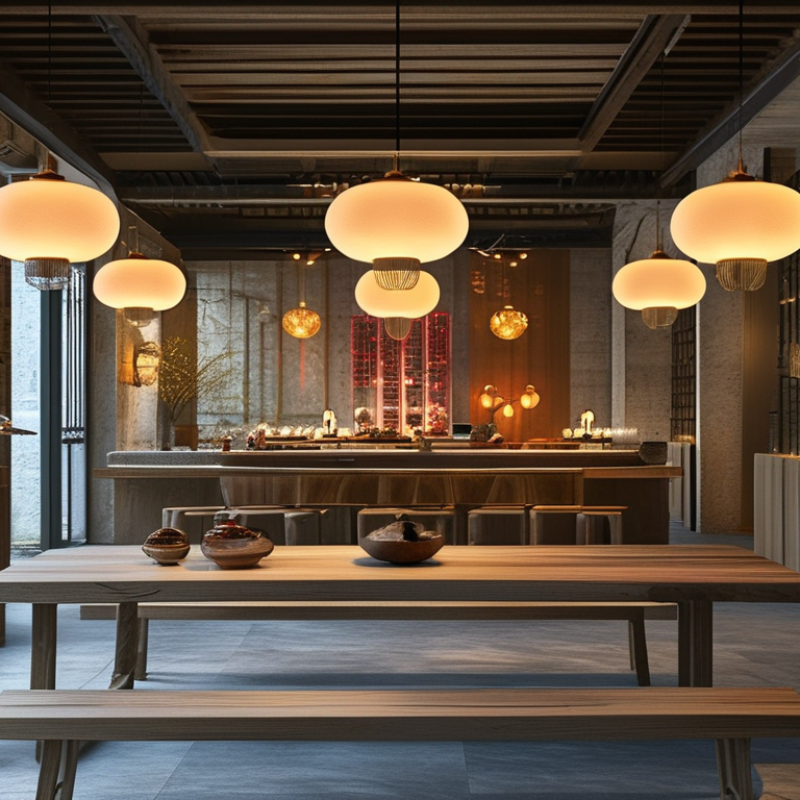
Decorative lighting design in China covers more than attractive fixtures. It shapes how people experience homes, hotels, retail interiors, public buildings, streets, and cultural spaces. The scope includes light distribution, color temperature, color rendering, materials, controls, installation, and maintenance. A warm 2700K wash on a stone wall feels very different from a cool beam on glass.
Urban demand is expanding. China’s National Bureau of Statistics reported an urbanization rate of 66.16% at the end of 2023. This growth creates more renovated apartments, commercial interiors, pedestrian areas, and public venues. The China Lighting Industry Association’s industry reporting also treats decorative applications as part of a wider lighting market, rather than an isolated category. That classification is useful, but it can hide the real value of decorative projects.
Energy performance now shapes design decisions. The International Energy Agency reported that LEDs represented about 70% of global general-lighting sales in 2022. In China, efficient sources, dimming, sensors, and connected controls are entering decorative schemes. Yet efficiency does not automatically create good design. A bright lobby can still feel harsh, and a complex control system may frustrate staff. Designers should test glare, shadows, nighttime appearance, and replacement access on site. I have found that small details matter: concealed profiles, accurate beam angles, and clean cable routes often influence perceived quality more than expensive decoration. Some plans still overuse color-changing effects. That deserves more careful reflection.
China’s decorative lighting history grew from practical needs and ritual meaning. Early households used oil lamps made from bronze, pottery, or simple wood. Han-period lamps often featured balanced forms and careful craftsmanship. Light was not only useful. It marked rank, worship, and domestic order. Later, paper lanterns brought warmth to streets, courtyards, festivals, and family gatherings. Their soft glow made architecture feel more humane.
During the Tang and Song periods, expanding cities encouraged richer night life and more varied lighting. Lantern displays appeared near markets, temples, and public celebrations. Red suggested happiness and protection, while gold often expressed prosperity and dignity. Yet these meanings were never completely fixed. Region, family tradition, and occasion changed their interpretation. That complexity matters when designers borrow traditional symbols today.
Modern Chinese lighting combines these memories with glass, metal, digital controls, and energy-efficient sources. A contemporary pendant may echo a courtyard moon gate or a folded paper shade. The reference can feel sincere, but it can also become shallow decoration. I once viewed red lanterns as a universal cultural symbol. That assumption was too simple. Good design requires research into local customs, materials, scale, and the way people actually use a room. Designers should also test glare, shadow, maintenance, and accessibility, not only visual beauty. The strongest future designs may preserve cultural structure while allowing quieter, more personal interpretations.
What Is the Future of China Decorative Lighting Design?
China’s decorative lighting industry is moving from visual spectacle toward connected, efficient environments. The National Bureau of Statistics reported an urbanization rate of 66.16% at the end of 2023. This growth supports demand for lighting in apartments, hotels, retail spaces, and renovated historic districts. Designers now use tunable LEDs, wireless dimming, occupancy sensors, and digital lighting controls. A warm 2700K setting can soften a dining area, while cooler light can sharpen a showroom display.
The technology is practical, not merely fashionable. The International Energy Agency’s Energy Efficiency 2024 report states that LEDs represented more than half of global lighting sales in 2022. The U.S. Department of Energy also reports that LEDs use at least 75% less energy and can last up to 25 times longer than incandescent lamps. These figures encourage Chinese manufacturers to improve heat management, optical efficiency, and modular repair. A smaller driver can also reduce ceiling clutter. The light feels alive.
However, smart lighting still has weaknesses. Sensors may react poorly to glass reflections or crowded rooms. Wireless systems can also create maintenance problems when protocols change. Decorative lighting should not become an expensive technical puzzle. Designers need simple controls, replaceable components, and clear energy data. The next challenge is balancing dramatic form with responsible material use. That remains difficult.
| Technology or Design Dimension | Current Industry Status in China | Representative Technical Data | Decorative Lighting Applications | Future Development Direction |
|---|---|---|---|---|
| LED Light Sources | LED technology is the dominant light source for new decorative fixtures because of its compact size, controllability, long service life, and compatibility with thin lighting structures. | LED packages and modules commonly achieve approximately 80–180 lm/W, while finished decorative luminaires usually provide lower system efficacy because of diffusers, optics, thermal design, and driver losses. | Pendant lights, wall sconces, linear profiles, cove lighting, illuminated furniture, architectural details, and customized artistic fixtures. | Higher efficacy, improved thermal management, smaller light engines, better color consistency, and more integrated light-source design. |
| Color Quality and Tunable White | Designers increasingly specify color quality as part of the visual identity of residential, hospitality, retail, and cultural interiors. | Common color temperatures range from approximately 2700 K to 6500 K. CRI 80 or higher is widely used for general applications, while CRI 90 or higher is preferred where material and product colors must appear more accurately. | Hospitality interiors, restaurants, galleries, retail displays, residential rooms, and spaces requiring different light scenes throughout the day. | More precise spectral control, better red rendering, reduced color variation between fixtures, and automatic adjustment based on time, activity, and daylight. |
| Smart Lighting and Connectivity | Connected decorative lighting is expanding from app-based control toward integrated residential, hospitality, commercial, and building-management systems. | Common control approaches include Bluetooth Mesh, Zigbee, Wi-Fi, DALI-2, wired 0–10 V, and other digital control interfaces. Compatibility depends on the luminaire, gateway, controller, and building system. | Scene setting, remote dimming, group control, hospitality room control, retail ambience, and coordinated architectural lighting. | Interoperable systems, easier commissioning, secure over-the-air updates, unified control interfaces, and wider adoption of standardized smart-home communication. |
| Sensors and Adaptive Control | Occupancy, presence, daylight, and environmental sensors are increasingly used where decorative appearance must be combined with energy management. | Typical systems combine occupancy or presence detection with dimming, time scheduling, and daylight-responsive control. Actual energy savings vary according to operating hours, space usage, control settings, and daylight availability. | Corridors, staircases, hotel areas, offices, retail spaces, public interiors, and residential common areas. | More discreet sensor integration, predictive control, occupancy analytics, and automatic coordination between decorative and general lighting. |
| Miniaturization and Flexible Light Forms | Compact LED modules, flexible strips, edge-lit panels, and integrated profiles have expanded the range of shapes available to lighting designers. | Flexible products are commonly specified by voltage, power per metre, color temperature, CRI, cut length, bending direction, ingress protection, and thermal installation requirements. | Curved pendants, concealed coves, illuminated shelves, furniture details, signage, transparent materials, and custom sculptural lighting. | Seamless light lines, thinner profiles, improved bendability, lower visible brightness variation, and easier integration into customized interiors. |
| Dynamic Color and Pixel Control | RGB, RGBW, and individually addressable LED systems are used mainly for experiential, commercial, entertainment, and architectural projects rather than ordinary home lighting. | Systems may support independent control of multiple LED segments, programmed color scenes, animation effects, and synchronization with external controllers. Visual uniformity depends on LED spacing, diffuser design, and control resolution. | Hotels, restaurants, retail façades, exhibition spaces, entertainment venues, themed interiors, and media-oriented installations. | Higher pixel density, smoother gradients, lower flicker, simplified programming, and better integration with interactive media and building events. |
| Human-Centric and Visual Comfort Design | Comfort, glare control, flicker performance, and appropriate brightness are becoming more important as decorative fixtures are used for longer periods and in wellness-oriented interiors. | Design evaluation commonly considers glare, luminance distribution, flicker, temporal light modulation, color temperature, and illuminance. Performance depends on the complete luminaire and driver, not only the LED chip. | Bedrooms, offices, schools, healthcare interiors, hospitality spaces, reading areas, and residential living environments. | Lower-glare optics, improved drivers, adaptive schedules, better spectral design, and lighting layouts that balance decorative effect with visual comfort. |
| Materials and Circular Design | Decorative lighting increasingly combines metal, glass, wood, textiles, recycled materials, and engineered polymers, while designers pay greater attention to repairability and end-of-life separation. | Relevant design factors include material durability, heat resistance, replaceable drivers, accessible fasteners, modular construction, packaging reduction, and separation of electronic components from recyclable materials. | Residential interiors, hospitality projects, retail environments, cultural buildings, and customized architectural installations. | Longer product lifecycles, replaceable components, lower-material construction, digital product documentation, and more transparent environmental assessment. |
| Manufacturing and Customization | China’s large lighting manufacturing ecosystem supports rapid prototyping, modular production, customized dimensions, and the integration of electronics with decorative structures. | Digital modeling, CNC processing, 3D printing for prototypes, automated assembly, optical simulation, and quality testing can shorten development cycles; final performance still requires electrical, thermal, photometric, and safety verification. | Bespoke chandeliers, artistic pendants, hospitality projects, commercial interiors, architectural feature lighting, and small-batch design collections. | Mass customization, digital-to-production workflows, faster sampling, modular replacement, and closer cooperation between designers, engineers, and interior architects. |
| Data note: Technical ranges are representative industry values rather than specifications for every product. Actual performance should be verified through the luminaire’s photometric report, driver documentation, safety certification, and applicable Chinese national or industry standards. | ||||
China’s decorative lighting design is moving beyond visual luxury. Sustainability now shapes the entire product life cycle. This pressure is changing Chinese interiors, from hotel lobbies to compact apartments.
LED technology remains essential. The International Energy Agency reports that LEDs can use up to 80% less electricity than incandescent lamps. Yet efficient hardware alone is not enough. Designers are adding occupancy sensors, daylight dimming, and app-based scheduling.
The U.S. Department of Energy notes that lighting controls can reduce energy use by 20% to 60%, depending on the building and control strategy.
A corridor should brighten only when someone enters. A pendant should not shine at full power all night.
Materials matter too. Recycled aluminum, replaceable drivers, and modular shades can extend product life. These details are less glamorous. They are more responsible.
Circular design is still uneven across China’s decorative lighting market, partly because repair costs can exceed replacement costs. That deserves honest criticism. Smart systems also need simpler interfaces, local control, and stronger data protection. Otherwise, connected lighting becomes another abandoned device.
The future may be warmer, quieter, and more efficient, but it will not be perfect.
China’s decorative lighting design is moving beyond visual glamour. Designers now face stricter energy targets, aging infrastructure, and rising expectations for healthier night environments. A bright lobby may look impressive, yet excessive glare can tire visitors and waste electricity. Site reviews often reveal another issue: beautiful fixtures may perform poorly in humid kitchens, narrow corridors, or dusty public spaces. Practical testing matters.
New opportunities are growing in cultural buildings, hospitality spaces, and residential renovations. Designers can combine local craft, recyclable materials, and programmable controls without copying historical forms. However, not every traditional motif works with modern light sources. That mistake deserves more discussion. Designers should verify color rendering, heat control, maintenance access, and electrical safety before approving a concept. Working with engineers and facility teams also improves reliability. Clear documentation builds trust with clients and contractors.
Tips: Visit the site at night. Measure glare near eye level. Test materials under warm and cool light. Leave space for cleaning and repairs. Ask whether the design still feels comfortable after ten minutes. Avoid treating smart controls as decoration. A simple scene may serve users better.
: Connected, efficient environments are replacing purely dramatic displays. Designers use tunable LEDs, sensors, wireless dimming, and digital controls.
Warm 2700K light can soften a dining area. Cooler light can make showroom products appear sharper. The effect needs on-site testing.
LEDs can use at least 75% less energy than incandescent lamps. They may also last much longer, reducing replacement work.
They should improve heat management, optical efficiency, and modular repair. Smaller drivers can reduce clutter above ceilings.
Sensors may react badly to glass reflections or crowded rooms. Wireless systems can become difficult when communication protocols change.
Measure glare near eye level during a night visit. A bright lobby may impress visitors, but excessive brightness can cause fatigue.
Cultural buildings, hotels, retail areas, apartments, and renovated historic districts offer strong opportunities. Local craft and recyclable materials can add character.
They should test color rendering, heat control, maintenance access, and electrical safety. Materials should be viewed under warm and cool light.
No. A simple lighting scene may serve users better. Smart controls should solve problems, not act as decoration.
Designers should work with engineers and facility teams. Clear documentation helps contractors understand cleaning, repairs, controls, and replacement needs.
Ask whether the space still feels comfortable after ten minutes. Good-looking fixtures can perform poorly in humid kitchens or dusty corridors.
China’s decorative lighting design encompasses the creative use of light, fixtures, materials, color, and control systems to enhance architectural spaces, public environments, and cultural settings. Its development has been shaped by traditional ideas such as harmony, symbolism, craftsmanship, and the relationship between light and nature, while modern designers increasingly combine cultural heritage with contemporary aesthetics. Advances in LED technology, digital controls, flexible materials, and customized production are making lighting more efficient, expressive, and adaptable.
Looking ahead, what is the future of decorative lighting design will depend on how successfully designers balance beauty, technology, sustainability, and human experience. Energy-saving systems, recyclable materials, smart sensors, and responsive lighting will support greener and more personalized environments. However, designers must also address issues such as energy consumption, light pollution, rising technical expectations, and the preservation of cultural identity. These challenges create opportunities for innovative solutions that connect traditional Chinese values with intelligent, environmentally responsible design.

Layr Light